

Pharma’s Sputnik Moment
Mutually assured drug discovery

“I’m really hoping your industry moves from drug discovery,” Jensen Huang quipped, “which is kind of like wandering around the forest looking for truffles.”
The other guy laughed, nodded, and by the time the session ended, agreed to commit a billion dollars over five years to Nvidia’s stack — talent, infrastructure, and compute. The two men shook hands.
The other guy was David Ricks, the chief executive of Eli Lilly — the most valuable pharmaceutical company in the world, a $700 billion firm built over a century, responsible for some ho-hum compounds like insulin, Prozac, and Zepbound. Ricks and Huang had been on a stage at the JPMorgan Healthcare Conference in San Francisco, widely regarded as the most important annual gathering in pharma.
These were two men, among the most important in their fields, which also happen to be two of the most important industries on earth.
The relationship has a hierarchy. There is a speed differential. There is an incumbent and an insurgent. And the insurgent is becoming a real threat to the incumbent.
Pharma is slow; AI labs are fast. Pharma is regulated; AI labs are not (as much). Pharma still believes it sets the terms of its own industry; AI labs already know it does not. Everyone in the room knew the hierarchy. Huang said it in a sentence, with a joke, and Ricks laughed along. Two men, one check.
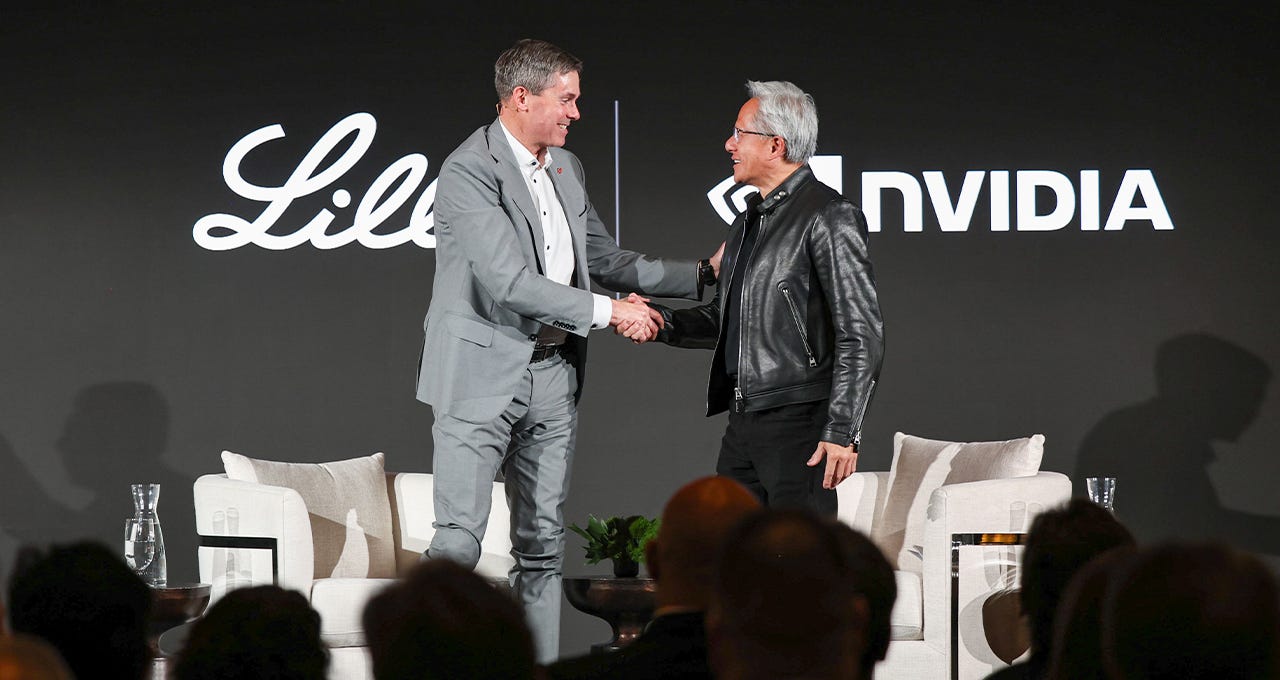
Eli Lilly had just bought ten million truffles.
“A century of human progress in science could be achieved by AI in just 5 or 10 years.”
Dario Amodei had said it from a stage at Davos a year earlier. Three months after the JPMorgan session, Anthropic quietly acquired the startup Coefficient Bio for $400m in stock. Coefficient was only eight months old, and had fewer than ten employees. It had no wet lab, no clinical capacity, no Investigational New Drug (IND) application. What it boasted was a small team that had come out of Genentech’s machine-learning brain trust, Prescient Design.
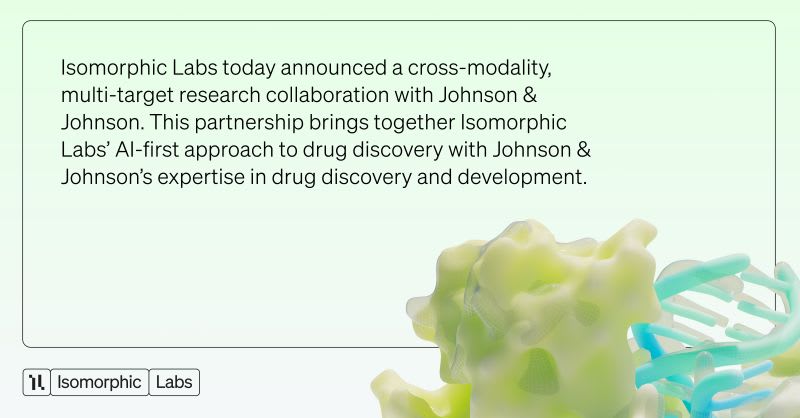
Anthropic is not the only foundation lab on the prowl. Within two weeks of the Coefficient deal, OpenAI announced its own pharmaceutical partnership with Novo Nordisk, and just two days later, launched GPT-Rosalind, a biology research agent built specifically for drug discovery workflows. Earlier in the year, Google’s Isomorphic Labs announced a research collaboration with Johnson & Johnson and now expects its first AI-designed compounds to enter clinical trials by the end of 2026. Every major frontier lab is making the same bet at the same time.
I’ve spent the last several months trying to explain to friends in tech why the frontier labs are racing into pharma, and why pharma — the industry that fifteen years ago would have responded to a GPU seller with a polite rejection email — is responding now with billion-dollar contracts and stage time at its most important annual conference.
Pharma is having its Sputnik moment.
The reason this matters past the boundaries of either industry is that the relationship being drawn between AI and pharma right now will determine, over the next decade, how fast new drugs reach patients, which diseases get pursued and which do not, and how much of that calculus happens inside companies whose decisions you can see versus inside companies whose decisions you cannot. It is the story of the system that decides whether the drug your father needs gets approved in three years or twelve.
For most of the last century, pharma was a unipolar power inside drug development. It set the timelines. It set the pace. There was no peer pressure. There was nothing upstream of it that could move faster, no force pulling it toward urgency.
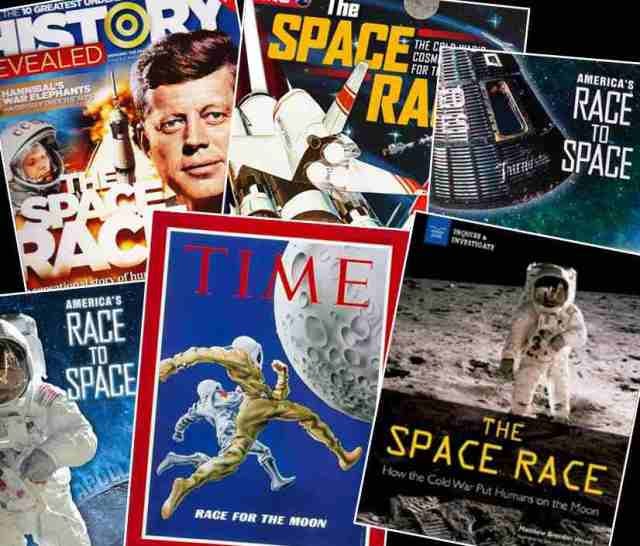
That has now changed. The frontier labs are not coming for pharma’s manufacturing or its trials or its distribution — they cannot, and I will get to why. They are coming for the part of the work that compounds in software, and they are moving at a speed pharma has never had to compete against. This is not a takeover. It is a forced partnership — closer, faster, and stranger than either industry has been in before. Two powers, neither able to fully absorb the other, each forced by the other’s existence to move faster than it would on its own. The space race was not produced by NASA alone. It was produced by NASA and the Soviets, in a relationship neither side wanted but both sides operationalized.
AI is not going to eat pharma. Pharma is not dying. But truffle jokes and biotech acquisitions are the same story told from two ends — in public, and on the cap table.
What are AI labs getting out of this?
