

The Magical Methane Machine
Casey Handmer left NASA to make fuel from thin air. Turns out it’s just as hard as it sounds

§ 01 ORIGINS
Casey Handmer was in seventh grade when he first thought about terraforming a planet. Handmer’s family lived in Sydney, Australia, and his father had taken him to see a talk by Robert Zubrin, an astronautical engineer and the founder of the Mars Society. Zubrin had become a sensation, embraced by Carl Sagan among other scientific luminaries, for his ideas about the colonization of Mars. He argued that instead of hauling materials from Earth, we should aim to establish a Martian outpost by manufacturing as much as we can once we arrive.
Young Handmer sat in the audience, rapt. He was a red-headed kid who hadn’t found his place in the world. After the talk, Handmer waited in line so that Zubrin could sign a copy of his 1996 book, The Case for Mars: The Plan to Settle the Red Planet and Why We Must, which Handmer stealthily read at school whenever he got a chance. “At one point, some kids grabbed it out of my hands and ripped it a bit, and I was quite upset,” Handmer said. Zubrin’s book may not have increased his popularity in school, but it propelled him toward an astrophysics Ph.D. program at Caltech which, eventually, landed him a job at the Jet Propulsion Laboratory in Pasadena, the heart of NASA’s Mars program.
At NASA, Handmer worked on projects mapping the surface of Mars, but that wasn’t enough Mars for him. In his free time, he developed his own roadmap for Mars colonization, complete with spreadsheets and CAD models. Martian settlers would need the technological equivalent of the Library of Alexandria—both the knowledge and the means to make a hostile world habitable.
One of the first things we would need is more fuel. We could fly there tomorrow, no problem, but we couldn’t carry enough juice for the return journey. A Martian outpost would also require an entire synthetic hydrocarbon supply chain for all the paints and oils and lubricants used in any industrial process. “How do you make fuel on Mars?” Handmer said. “Well, you make it from carbon dioxide, which is in the atmosphere, and water, which is in the dirt.”
The chemistry was not new. It broke no laws of physics. It was just energetically costly. It wasn’t long before Handmer started to wonder why we shouldn’t begin harnessing this process right here on Earth. By filling our skies with carbon dioxide, we had already been terraforming a planet, just the wrong one and in the wrong direction. Making synthetic fuels couldn’t reverse the damage we had done, but it wouldn’t make it worse.
Handmer drove a Tesla, and he thought electric vehicles were a step forward. Batteries alone, though, would not solve the climate crisis. They can’t power container ships, airplanes, or rockets. Not for the foreseeable future. One gallon of liquid fuel contains ten times as much usable energy as a lithium-ion battery of the same weight. Methane, or natural gas, is also used in the production of nitrogen fertilizer, which made the entire green revolution possible.
The question was not whether we’ll still need hydrocarbons in 2050, but where they would come from. Handmer became determined to give the world what he called “Texan levels of energy wealth.” Instead of fracking the Permian Basin or plumbing the depths of Saudi Arabia, he’d make the hydrocarbons with a machine that ran on air, water and sunlight. Mars would have to wait. Earth would come first.
§ 02 INTEGRATION TEST
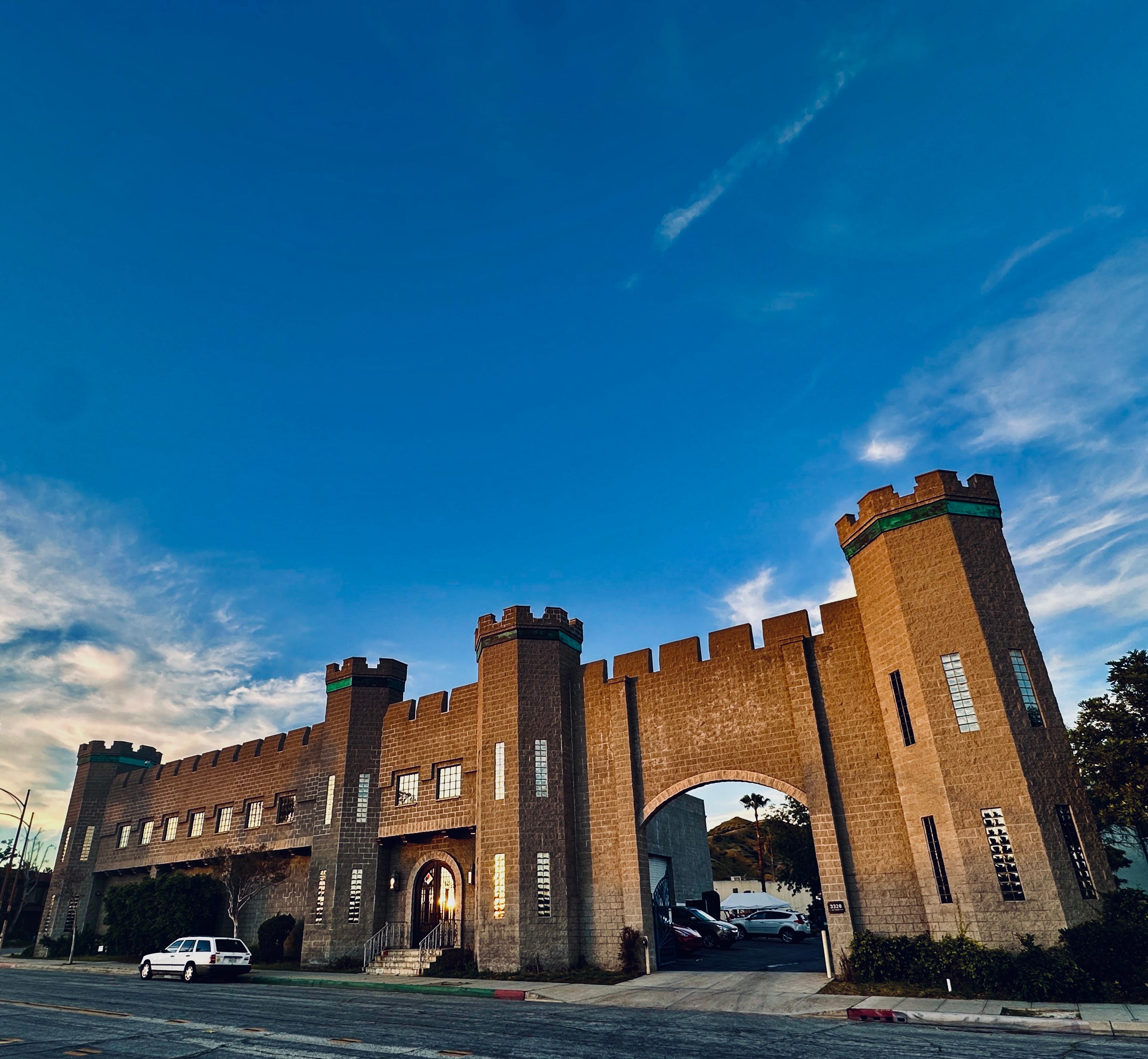
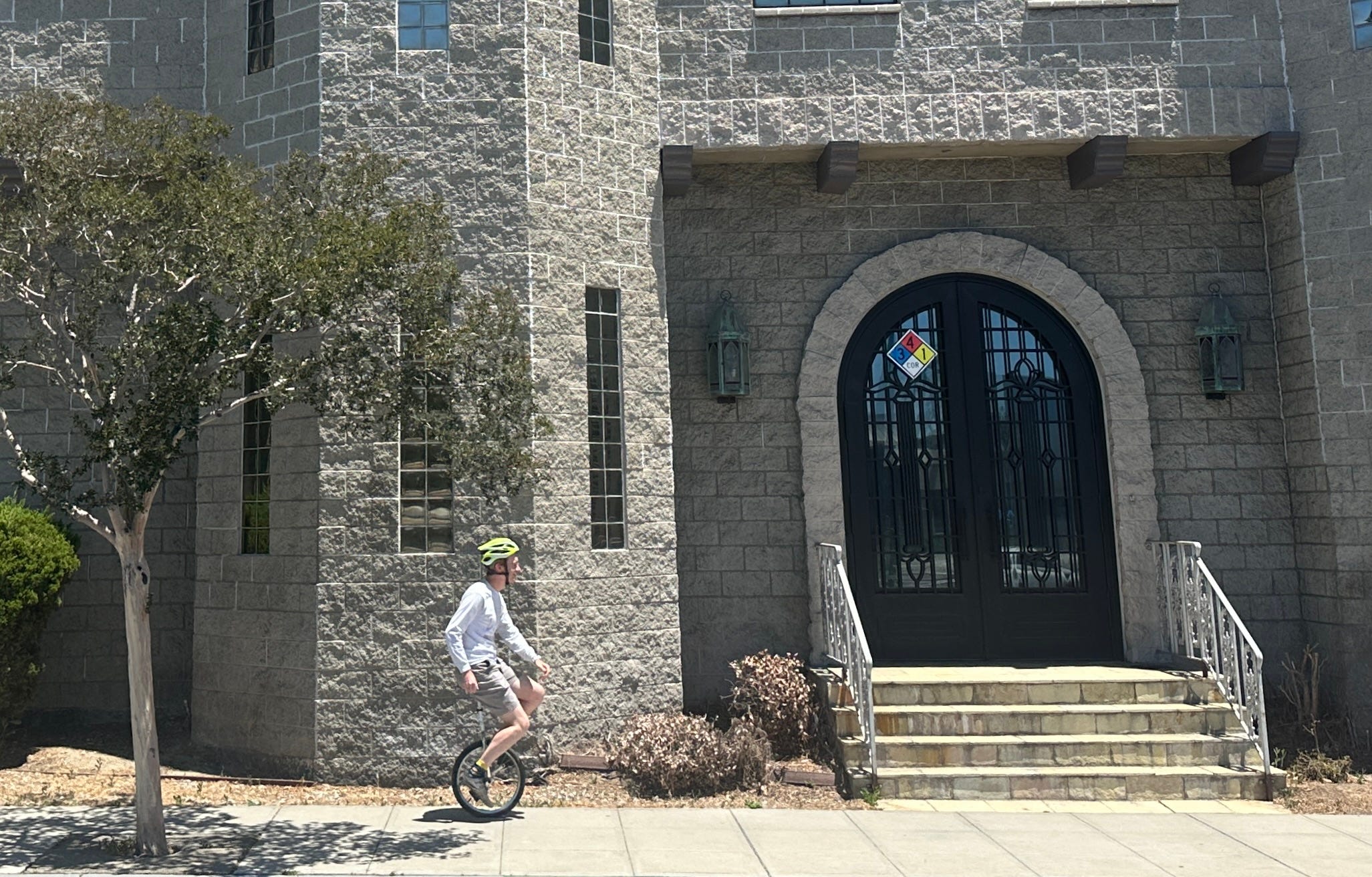
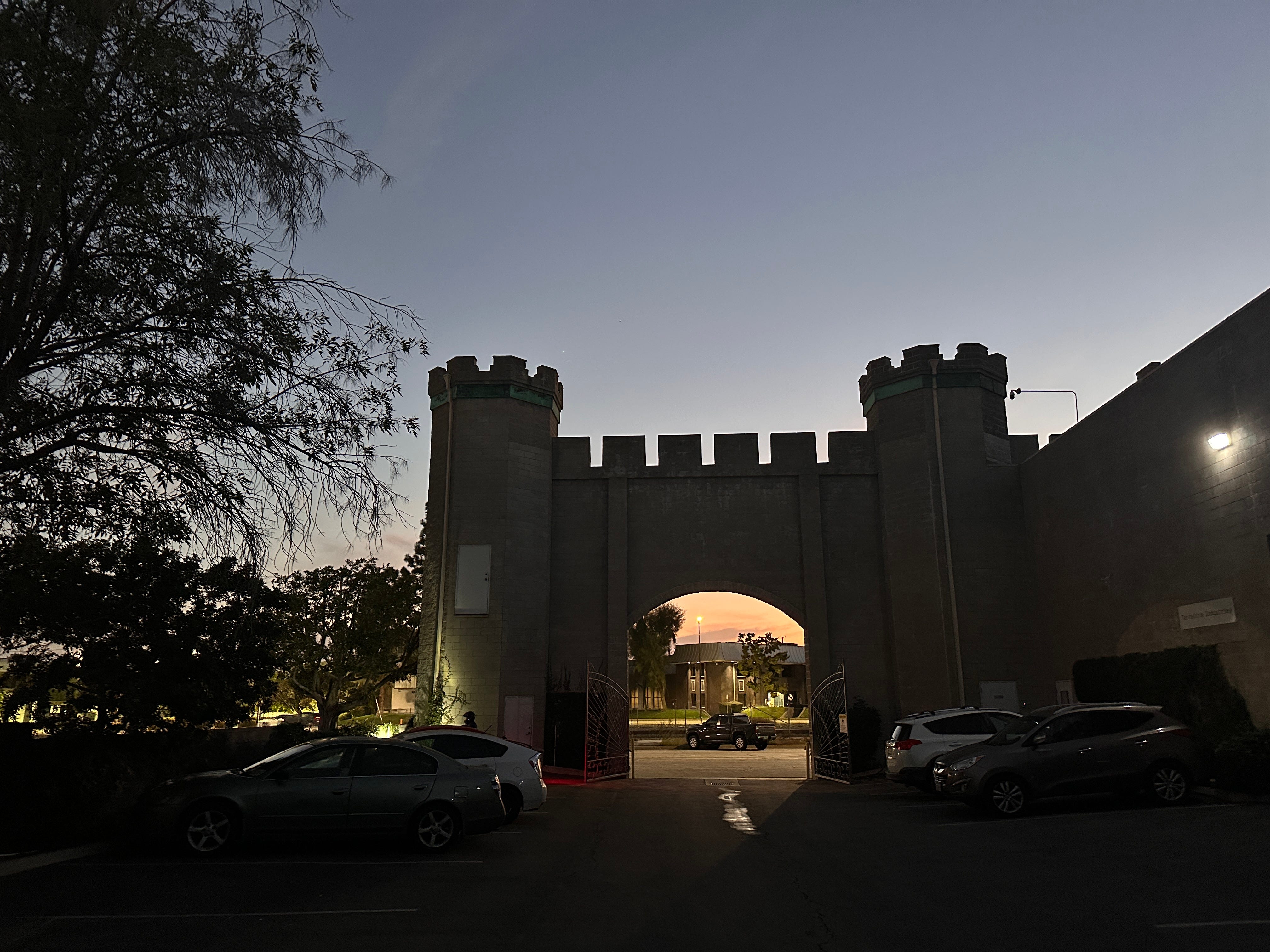
Burbank, California. November 2025. Blue skies above Interstate 5 faded into a band of haze the color of an armpit stain. Eight turrets rose over the roofline of the headquarters of Terraform Industries, which looked like a knockoff medieval castle dropped into a neighborhood of auto body shops and Armenian restaurants.
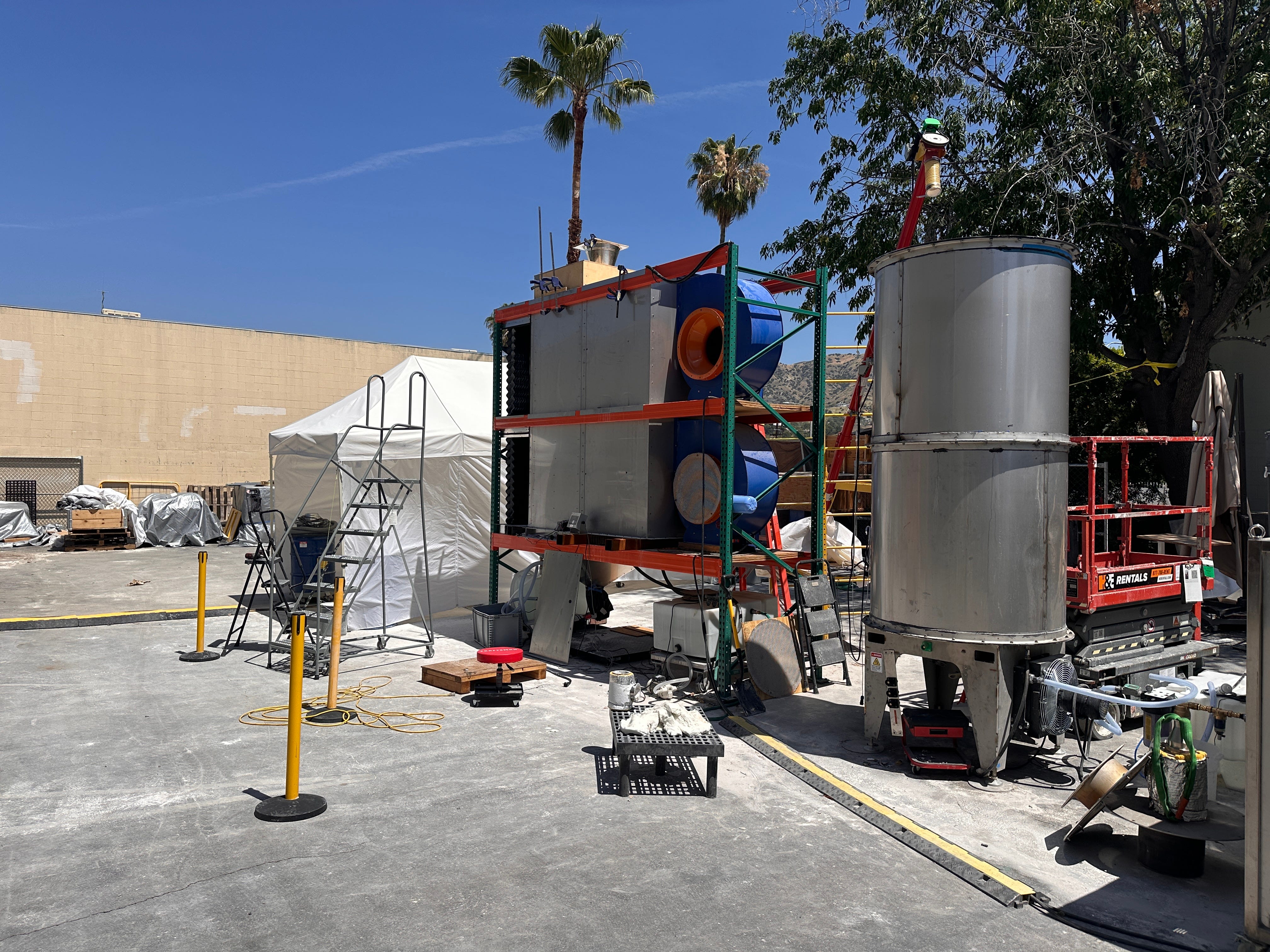
Under a tent in the attached parking lot sat part of the Mark One Terraformer. The Mark One wasn’t much to look at. It was a series of tubes and boxes made of plywood and steel. The asphalt below was tinted by a halo of white powder.
Terraform Industries, which Handmer founded four years ago, had spent more than half of the $37 million in capital it had raised to reach this point. Over the next two and a half weeks, the Mark One would be put to the test. For the first time, all three of its subsystems would be run together in a single process to continuously produce synthetic methane from air and water.
Handmer chose methane because it was the simplest hydrocarbon to make: a single carbon atom surrounded by four hydrogens. The process starts by pulling carbon dioxide out of the air with that white substance, which is quicklime, or calcium oxide—a key ingredient in cement. When the quicklime absorbs carbon dioxide, it becomes limestone. Limestone is stable until you heat it up to high temperature, which releases the now-concentrated carbon dioxide. Meanwhile, you run electricity through some water to split it into hydrogen and oxygen. You bag the hydrogen and vent the oxygen. Finally, you pipe the carbon dioxide and hydrogen into a reactor in the presence of a metal catalyst. The atoms swap partners, generating methane and water. Easy.
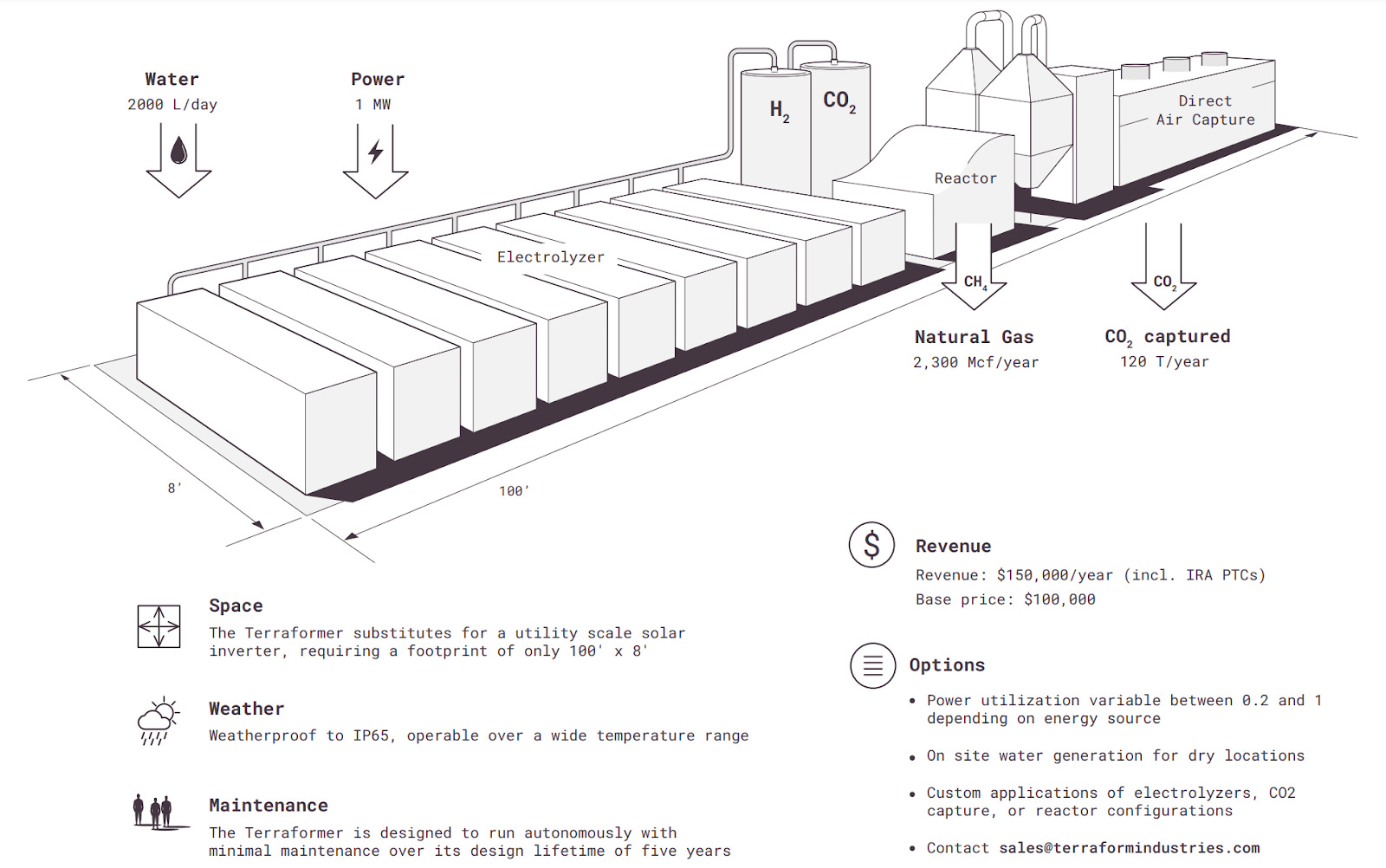
Once complete, each Terraformer was expected to produce 2 million cubic feet of natural gas per year at a price that, if all went well, would be competitive with the stuff coming out of the ground. Handmer envisioned a future, two decades down the line, where a fleet of 400 million solar-powered Terraformers gave the world permanent energy abundance. Natural gas was just the first step. He had concepts for Terraformers that could desalinate water, synthesize fertilizer, and manufacture advanced alloys anywhere the sun shines.
But first his team needed to get the Mark One Terraformer to work. Their deadline was set for the day before Thanksgiving.
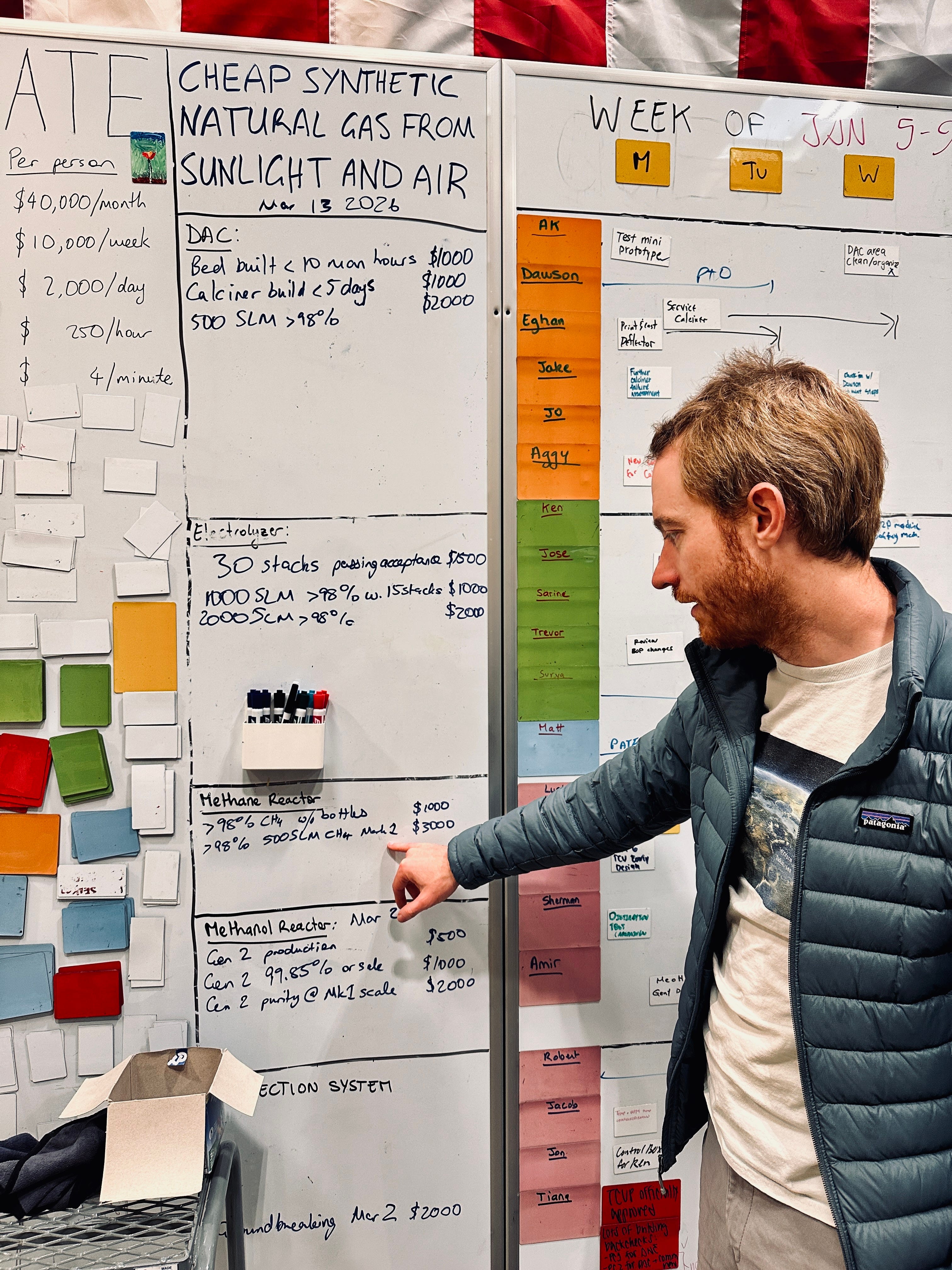
Inside the castle, the company’s twenty employees had all gathered in front of a wall of whiteboards, crowded with arrows, names, and numbers. Handmer stood at the front in a T-shirt and jeans. He was 38 and looked more like a graduate student than a chief executive. He spoke like a podcast playing at 1.25x.
“We’re no longer little, tiny marmot-like creatures trying to avoid being stomped on by the dinosaurs,” Handmer told the team. Over the last four years, he said, he had been tracking his competitors on a spreadsheet and half of them were now dead—or close to it. “We have a differential advantage over our competitors at doing hard shit.”
Behind Handmer, the subsystems in the parking lot had been reduced to colors. Orange cards marked the team capturing carbon dioxide. Green cards tracked the effort to make hydrogen. Pink cards represented the step where the two would be brought together as methane.
To the right of these cards, the November milestones stretched out. Calciner welding. Catalyst loading. Stack test. Each milestone was boxed, dated, and assigned. A monetary award was attached to each one.
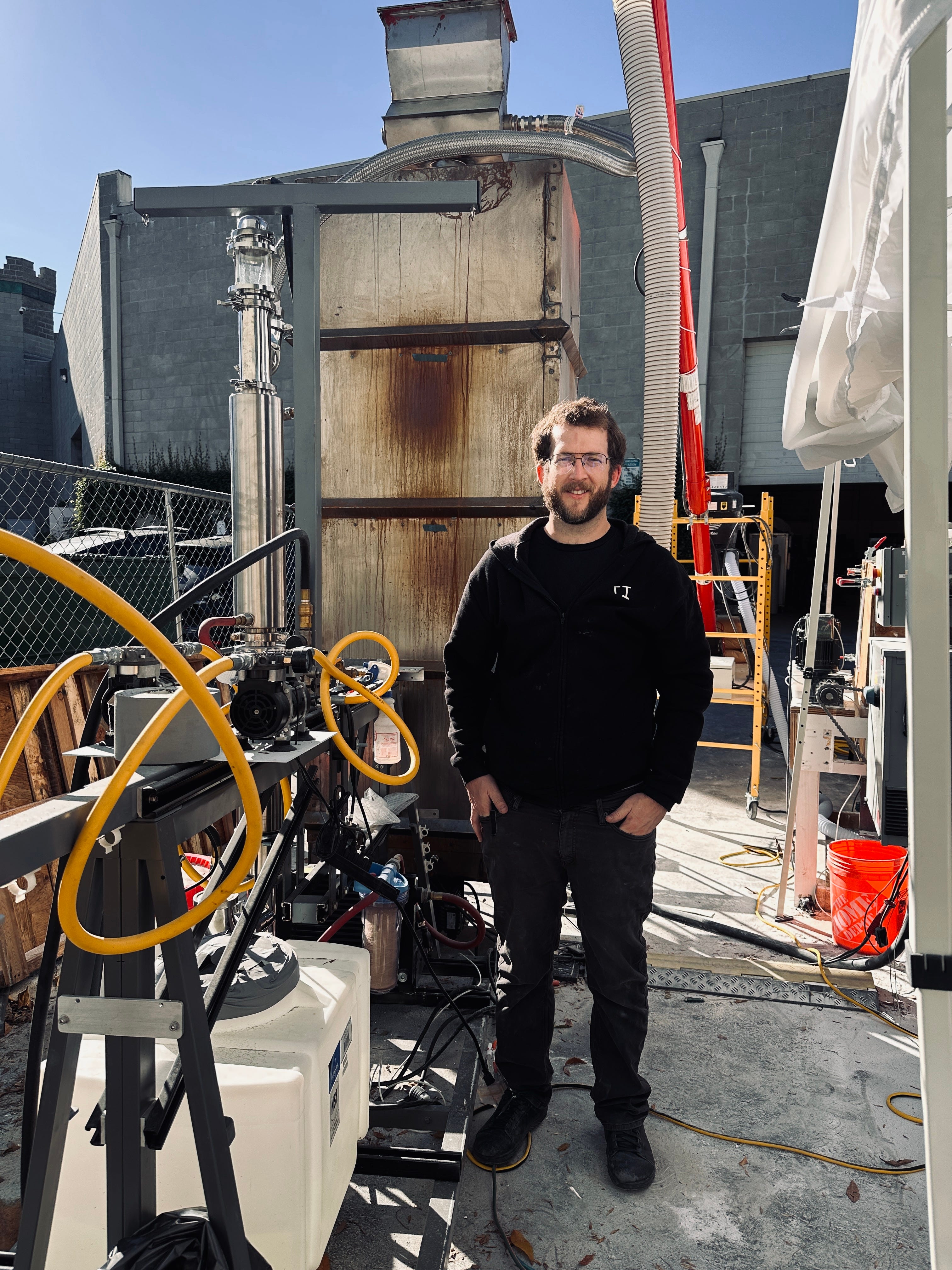
They went team-by-team to discuss their integration plan for the Mark One. Dawson James, the mechanical engineer leading carbon capture, said the heating element of the calciner—the furnace used to heat the powder—would be ready to break in by midweek, with carbon dioxide collection by Friday. Rain was in the forecast. “If it’s sealed gas-tight, it should be sealed watertight,” he said. “I’m not too worried. I’ll put a little cover over the top.”
James’s task was one of the hardest in the building. Despite its outsized impact on the climate, carbon dioxide is a relatively rare ingredient in the air around us. If you gathered, say, 10,000 molecules from the air and placed them inside a box—a very, very, very small box—just four of those would be carbon dioxide.
It costs Climeworks, the behemoth of the climate-tech world, about $8 to capture the carbon released by burning a single gallon of gasoline. For Terraform Industries to be viable, James needed to do the same thing at a tenth of the price.
Lucie Nurdin, a chemist from France, who oversaw the reactor that made methane, flagged the risk on her side. “From our perspective, the injection system and the reactor have the most hazards associated with them,” she said. “We are going to flow 2,000 SLM (standard liters per minute) of hydrogen at seven bar. We have about sixty kilowatts of energy dissipated at any time—so it’s no big deal.”
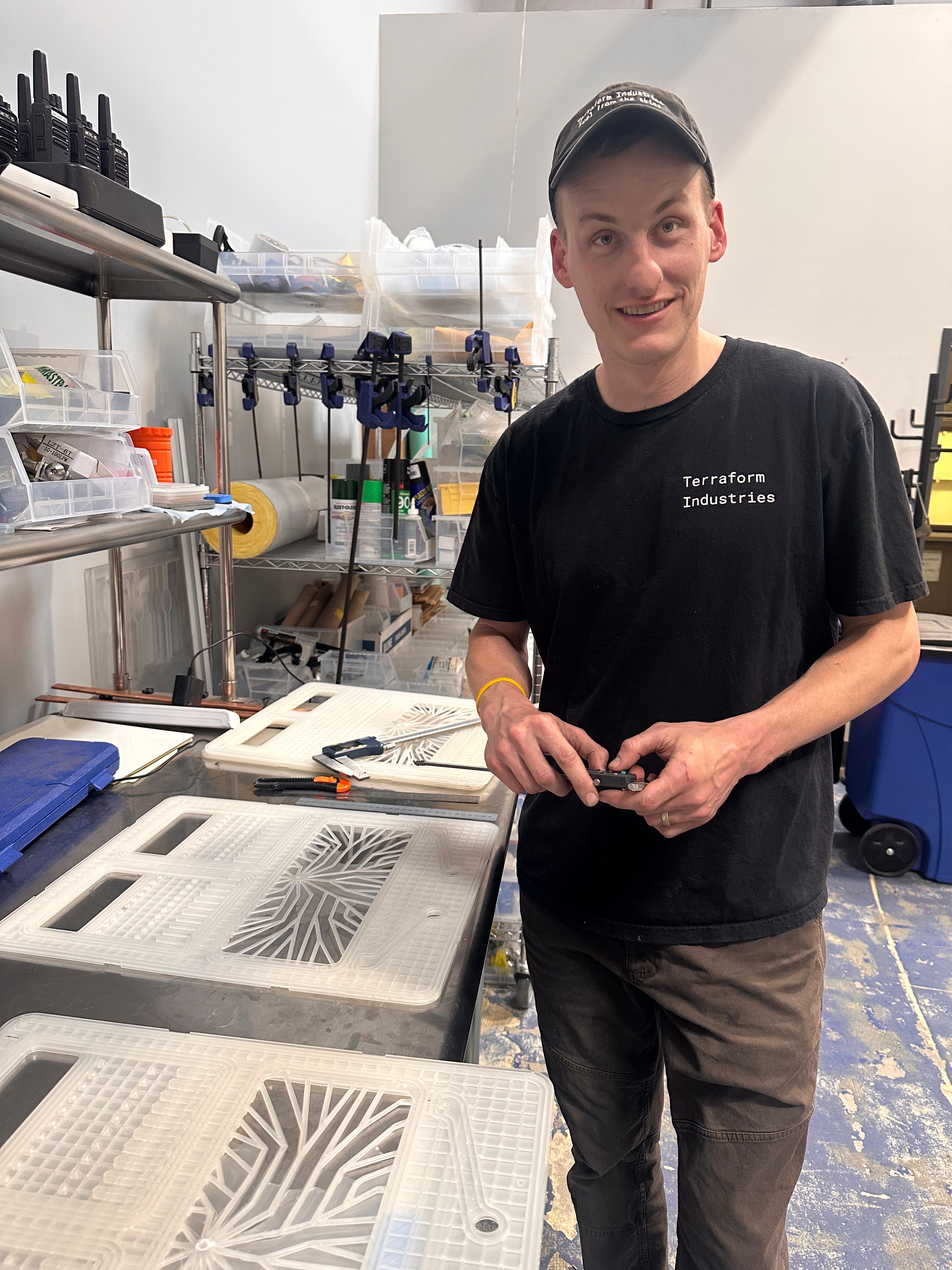
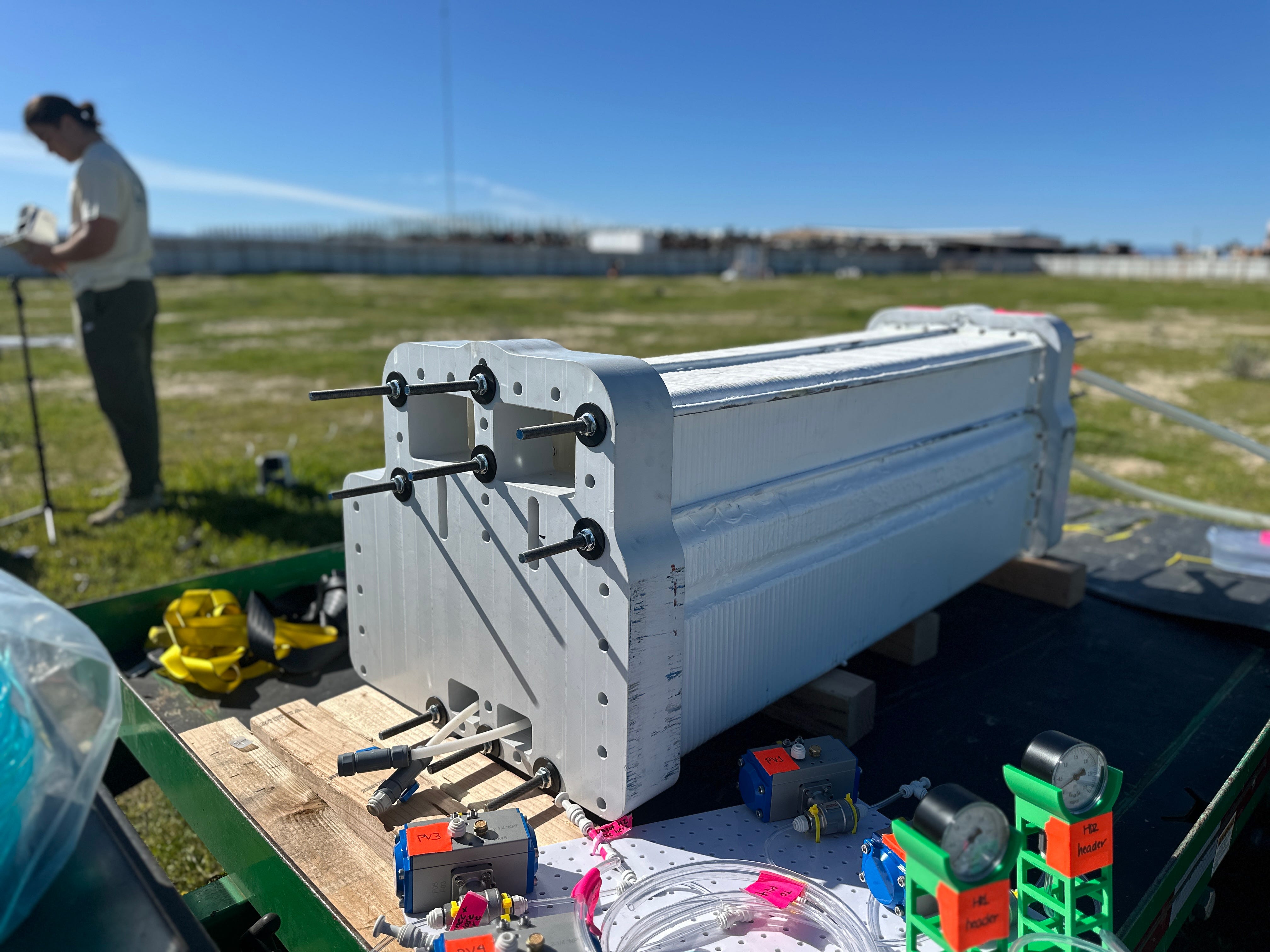
The electrolyzer team, which made the hydrogen gas, also sounded upbeat. Their latest design, the 22nd generation, was a winner. Each of these electrolyzer stacks weighed as much as a refrigerator and had a hundred interlocking plastic cells clamped together with five long metal bolts like a spinal column.
The stacks were the most power-hungry part of the Mark One. During operation, one long chamber filled with oxygen. The other chamber filled with hydrogen. To prevent the gases from crossing over between cells and producing an explosive mixture, the team had tried flat rubber gaskets, which were fussy and expensive. They had tried O-rings, which were cheaper but even fussier. They resolved to put headers on either end and compress the stacks with those bolts until they were leak-free, or nearly so. “Everything leaks,” Handmer liked to say.
Like livestock, each stack was given an unofficial name by their caretakers. The team leader, Trevor Yamamoto, said they’d hit 99% hydrogen purity on the newest stack, “Let Me Split That For You,” and bumped that up to 99.9% after scrubbing out residual oxygen. “That’s really promising,” he said. The plan for the week was to keep building and testing new stacks, one of which would be dubbed “Mrs. Doubtfire” and the other “Baruk Khazâd,” after the dwarves’ war cry in The Lord of the Rings.
Handmer hung on Yamamoto’s words with a sense of accomplishment. “For most of this company’s existence, we have never had a functioning electrolyzer physically present,” he said. “We build one, we blow it up and are scratching our heads trying to figure out what to do next.”
Something had shifted in recent weeks. “The Building Electrolyzers team has defeated the Blowing Up Electrolyzers team,” he said. “It’s very encouraging, because one day we hope to be a net producer of electrolyzers in the world.”
§ 03 A SHITLOAD OF WATER
After Monday’s meeting, the milestones on the whiteboard began falling one-by-one. More stacks were built. The heating elements were broken in. The catalyst was activated. On Thursday, two major boxes for the week remained unchecked: “Calciner Testing” and “Methane Production.” Both were scheduled for Friday, November 14th.
That afternoon, Lucie Nurdin’s team took the methane reactor on its second test run of the day. The reactors looked like two highly instrumented water heaters. They were about seven feet tall, swaddled in fabric insulation.
Nurdin’s target was 97% methane at the outlet. Instead, the readout stalled at 6%.
A sniffer sensor near the reactors began beeping—a sign that it was detecting hydrogen in the air. It was still far below the explosion threshold, but it was just another thing that the team needed to be mindful of.
Then came a sudden hiss. Nurdin shot up. “Cut off the CO2,” she said, grabbing a radio and heading outside.
After a moment, she buzzed in: “Guys, it’s the water. We’re making a shitload of water.”
Under the Sabatier process, which was invented by a French chemist in 1896, two molecules of water are produced with every molecule of methane. Too much water meant the system wasn’t draining fast enough, which could poison the catalyst. It was still too early to know whether they were heading in the right direction.
The testing tension at the castle was increasing thanks to an environmental anomaly. Los Angeles was experiencing weather. In the form of rain. A proper rain.
Around the corner of the building, Dawson James had flipped the switch on the 480-volt power supply feeding the calciner a few hours before the skies darkened. Raindrops now thumped on the tents and tarps the team had thrown up over their equipment. Water streamed across extension cords. Employees moved through the parking lot swamp in knee-length ponchos and dust masks. Flakes of limestone emerged from a conveyor belt inside a plywood box and glommed into pale mush.
The glow of a computer monitor reflected off James’s rain-splattered glasses. He gestured toward a wooden pallet on the ground. “We made a little bridge today, but all the water from the building goes right through the center of the test area.”
Outside the tent, the metal shell of the calciner sizzled and steamed. Inside, the temperature had reached 895 degrees Celsius. Hot enough to melt sterling silver. Still 200 degrees shy of its target.
Once it reached temperature, the limestone would be ground into powder and fed into the top of the calciner. Each particle would fall eight feet through the brick-lined chamber in about four-fifths of a second, during which time it would release its payload. Particle-by-particle, carbon dioxide would displace the air.
If James could capture that gas at 85% purity by midnight, Handmer had a thousand-dollar reward waiting for him. What he was watching instead was a slow-motion heist, perpetrated by the laws of thermodynamics. Each raindrop in the air stole a few more microjoules of heat at a time. The temperature curve flattened. The system was bleeding energy.
One piece of equipment had already shorted out. The water level was creeping toward a power board. James needed to keep the calciner running for another two hours at a minimum. The fabricator on James’s team, a metal sculptor from the Sierra foothills, stepped out of a garage bay and held up a fiberglass electrocution rescue hook—the kind used to safely yank a person off live wires.
By the end of the day, everyone had given up. Over the next two weeks, the company blew past its Thanksgiving deadline.
§ 04 WHATEVER I WANT
Handmer’s desk was among the messiest at the company. He preferred to sit in the thick of it all, in the hangar-like space where employees worked side by side.
His workspace was no larger than anyone else’s, but it was crowded with trophies. Polished metal spheres—tungsten, magnesium, and aluminum—sat next to a pile of papers. There was also a slice of a meteorite and a Curta mechanical calculator.
These were the rewards he had bought himself each time he accomplished something substantial. In 2024, for instance, he made national news by discovering a clue in the scans of a series of blackened, ancient Roman scrolls that allowed them to be deciphered. A business card propped up on his keyboard had a single sentence on it: “I can do whatever I want.”
NASA was not a natural home for this kind of thinking. Handmer’s wife, Christine Corbett, who is also an astrophysicist, worked in another department there. While Corbett was deft at climbing the organizational ranks, Handmer couldn’t handle the institutional inertia. “I just adapted to my environment,” she told me. “He got more and more disillusioned over time.” Handmer poured his energy into a personal blog, hammering out densely reasoned barnburners about NASA’s failings, among other topics. These earned him a following in Silicon Valley and a few reprimands from his supervisors. Corbett could already see how this story would end.
Corbett suggested that Handmer reach out to Patrick Collison, one of the co-founders of Stripe, to discuss his synthetic fuel idea. She had worked with Collison on a Wikipedia app, and he had attended their wedding. Collison was intrigued. In 2021, he and his brother John along with two other prominent investors, Nat Friedman and Daniel Gross, made Handmer an offer. They weren’t ready to invest in the idea, but they were willing to invest in him. They gave Handmer $100,000 to keep doing what he did best: brainstorming.
The chemistry required to make synthetic fuels was more than a century old, but the processes required so much energy it was hardly worth it. The existing companies designing electrolyzers and other types of industrial equipment needed for the work tended to prioritize energetic efficiency, which drove up the cost of their products.
Handmer, though, believed that the industry had missed the relentless progress of solar technology over the past two decades. With solar now pennies a kilowatt, he realized that energy was no longer a scarce resource. Capital was. The incumbents were building Porsches when the world needed Pintos.
Handmer also realized that it made sense to think small. He couldn’t imagine spending ten years building a billion-dollar plant that would be obsolete by the time it came online. Nor did he want to deal with an aging electrical grid. He needed to focus on a product: small, standardized reactors that could be deployed quickly and improved from one generation to the next like an iPhone. Economies of scale, he knew, came not by building bigger plants but by building more of them. The goal was for the system to cost less than a tractor, so that it could be purchased by a farmer in Iowa, a remote village in Alaska, or any industrial company that finds it’s easier to make their own gas than to pipe it in.
One morning, I met Handmer at the home he shares with Corbett and their children, on a narrow, winding road at the base of Mount Wilson in the San Gabriel Mountains. He took me out to his overstuffed garage to show me some of the artifacts from the earliest days of Terraform Industries: Nalgene bottles, glassware, a hobbyist kiln, and a bag of aquarium sand. It was hard to imagine that he could have achieved much out here with such rudimentary tools. “I wanted to validate my intuition that it was possible to do it radically cheaper,” he explained. “Which I did.”
Handmer quit his job at NASA and received $5 million in seed funding, which allowed him to move the company out of his garage and into the castle. Two years later, in March 2024, his growing team posed for a group photo after successfully producing methane from air and water in a pilot trial. “What keeps me up at night is that the oil and gas industry turns over $1 b/hour,” Handmer wrote his investors afterwards. “That wealth is right there and we’re so close to tapping into it.”
A few years ago, Zubrin signed another copy of his book for Handmer’s own son, and the two men have maintained an email correspondence. Handmer thought Zubrin might want to hear about Terraform Industries. “He told me synthetic fuels were a waste of time,” Handmer recalled.
He shrugged it off. He didn’t need Zubrin’s approval. He could do whatever he wanted.
§ 05 THE ANOMALY
While the outside world saw Terraform Industries as Handmer’s company, Handmer wanted his employees to see the Mark One Terraformer as their machine. Each subsystem was made up of smaller systems. He wanted each employee to take ownership of one complete system. Jake Kremer built the flake grinder. Eduardo Rosales built the temperature control unit. “It is better if it’s their machine,” Handmer told me one day.
When Handmer wasn’t fundraising or interviewing job candidates, he used his free time to pursue his side quests. His projects ranged widely, but they all pointed toward the sky. During technical meetings, he squinted at microscopic lines of code on his phone. He had recently submitted a proposal to NASA to beam power to the moon. And one afternoon I found him at his desk, zooming into a high-resolution map he had patched together of the surface of Mars. “Have you seen photos of this crater?” he asked me. “Hold on to your butt!”
It was easy to see these as distractions, but Ken Nelson, who worked on the electrolyzer team, told me that Handmer’s brain didn’t work like yours and mine. His extracurricular activities were the “extra sauce” that gave him his spark and the company its identity. “The whole culture is wrapped up in Casey,” he said.
Whenever I asked anyone enough questions about their machines, I always found Handmer’s fingerprints: a deleted part, a derivation on a whiteboard, or a probing question that triggered a redesign. For instance, Handmer had pressed the electrolyzer team to reduce the number of bolts on its stacks from thirty-three down to just five.
The morning of December 8th started like any other Monday, and full integration remained as the company’s most pressing quest. After the weekly meeting, employees scattered to return emails and get to work. Johanness Nilsson, a technician on the carbon capture team, was seated at his workbench doing some web browsing when he heard the boom.
There were a lot of noises around Burbank. Helicopters taking off. Things being thrown in dumpsters. Gunshots, even. “No, this is an explosion,” Nilsson thought. “That’s a distinct pressure wave.”
He hurried into the other room. Employees were shutting down the power to the electrolyzer stacks outside. Something had gone terribly wrong. No one was hurt, but “Let Me Split That For You” and “Baruk Khazâd” had both blown, catapulting white pieces of plastic onto the neighboring roof.
“Has anyone said anything to Casey?” someone asked after a while.
It was Nelson, who also served as the company’s safety officer. The others shook their heads. Handmer was on the other side of the building sitting at his desk, strategizing about a new funding round. He looked up. “Hey,” said Nelson. “You need to come see this.”
Handmer pushed through the vinyl curtains and into the electrolyzer room, then out the back door, where the shattered stacks sat in a puddle of water. They looked like they were missing teeth. The long bolts that held them together were charred, pointing toward an electrical short.
The team had taken the compression design to the limit, and it had failed. For those inside Terraform Industries, it was disheartening to be so close to achieving integration and be forced to retreat.
Handmer took the long view as he flew back to visit his parents in Australia over Christmas. “We weren’t planning to blow anything up, right?” he told me. He compared the company’s travails to those of SpaceX in its early days. “We’ve slipped relative to our ideal schedule by a factor of two or three, which sounds bad, but in hardware, seven to ten to infinity is more common.”
The truth, anyway, was that the company’s most existential challenge revolved more around economics than engineering. The gap between the price of pipeline gas and the cost of what Terraform Industries was aiming to sell seemed impossibly large. Solar was cheap but still not cheap enough. Halen Mattison, the founder of General Galactic, had recently pivoted away from synthetic fuels. He told me that the problem wasn’t the price of the synthetic fuel system or the solar modules themselves, but the price of labor, permitting, and land.
Handmer said that if he had known how hard this would be from the beginning, he probably would have never tried. “Think how many millions of humans have struggled to get us here from the stone age, right?” he said. “And, yet, you know, we are as gods.”
§ 06 BACK TO WORK
Three months after the explosion, the parking lot at Terraform Industries looked abandoned. Dawson James’s calciner, now coated in rust, had been relegated to a far corner. The second stage of the methane reactor had been decommissioned. The conveyor belt used to carbonate the flakes would soon be torn into pieces and thrown into a dumpster. As for the electrolyzers, the team had scrapped their compression stack design. Several employees had departed the company.
Handmer walked around the shop floor with Stephanie Coronel, who had met Handmer back at Caltech. She had been with Terraform Industries since its earliest days and proved adept at bringing Handmer’s brain into the room when it was needed and letting it roam when it was not. They had come to grill James on his progress building a new calciner.
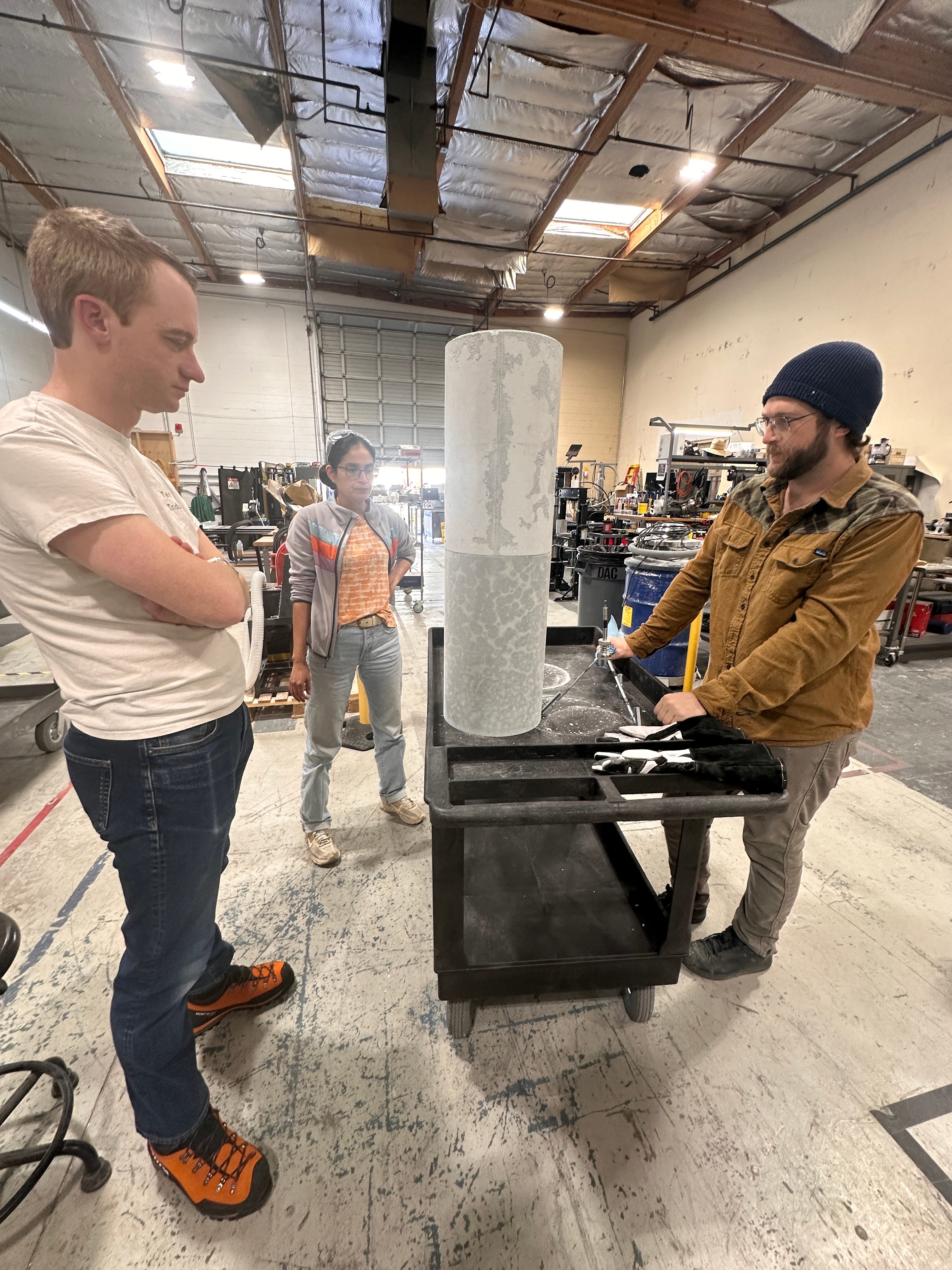
The old calciner had successfully captured carbon in December, but the heating elements ended up fizzling out after a clog. He was now using a lathe to cast ceramic tubes for a new iteration. These tubes would form a chamber separating the caustic flakes from the silicon carbide heating elements.
He hadn’t yet optimized his recipe. One of the tubes had a long, thin crack in it. “What are we doing to make sure we don’t have these kind of problems when we try to cast another one with the same conditions?” Coronel asked.
James said that he was trying to work out a gentler start-up sequence for spinning the molds. “That worked on this one, but the material is too thick . . . so we’re increasing the liquid content 3%, that will be in between these two.”
“What if that’s not enough?” Coronel pressed. “Are you going to increase it a little more?”
They went back and forth about James’s Goldilocks problem. Handmer cut in. “I feel like we’ve been constipated for weeks on this stuff,” he said. “I cannot come back from paternity leave, and we still haven’t given birth to this thing.”
Despite the growing impatience, good things were emerging from the redesign. Lucie Nurdin hadn’t needed that second reactor after all. She was able to use a recirculating design to maintain the same flow rate with a single reactor. The electrolyzer team, meanwhile, was welding their plastic stacks together to seal them. This innovation would eliminate all the bolts and cut their hardware costs by three-quarters.
James’s new calciner was even closer to a production model. It could handle twice as much material, while also being cheaper and lighter than the previous iteration. Late one morning, I watched him strap it to the company forklift and move it out of the shop.
A small crowd had gathered in the parking lot. They squinted at the steel body in the sun. James lowered it onto the concrete. For a moment, no one said a word. Then, they got back to work.
§ 07 MUROC
Handmer, in aviator glasses, sat behind the wheel of his Tesla as we dropped down the back side of the San Gabriel Mountains and into the pan of the Mojave Desert. The color drained from the landscape.
It was now late April. The war with Iran had sent oil and gas prices soaring. Qatar, which controls one-fifth of the world’s liquefied natural gas, shut down its export terminal following drone attacks.
Terraform Industries’ bet on synthetic fuels was looking smarter with each tick of the futures market. The reactor team had their process dialed in, which meant they were producing methane every time they turned on their machine—albeit with hydrogen and carbon dioxide from tanks. They had started bottling and selling their own output, and high-grade, bottled gas commands over a hundred times the price of pipeline gas. They were also making methanol, a precursor to gasoline and jet fuel, which offered a higher profit margin than methane.
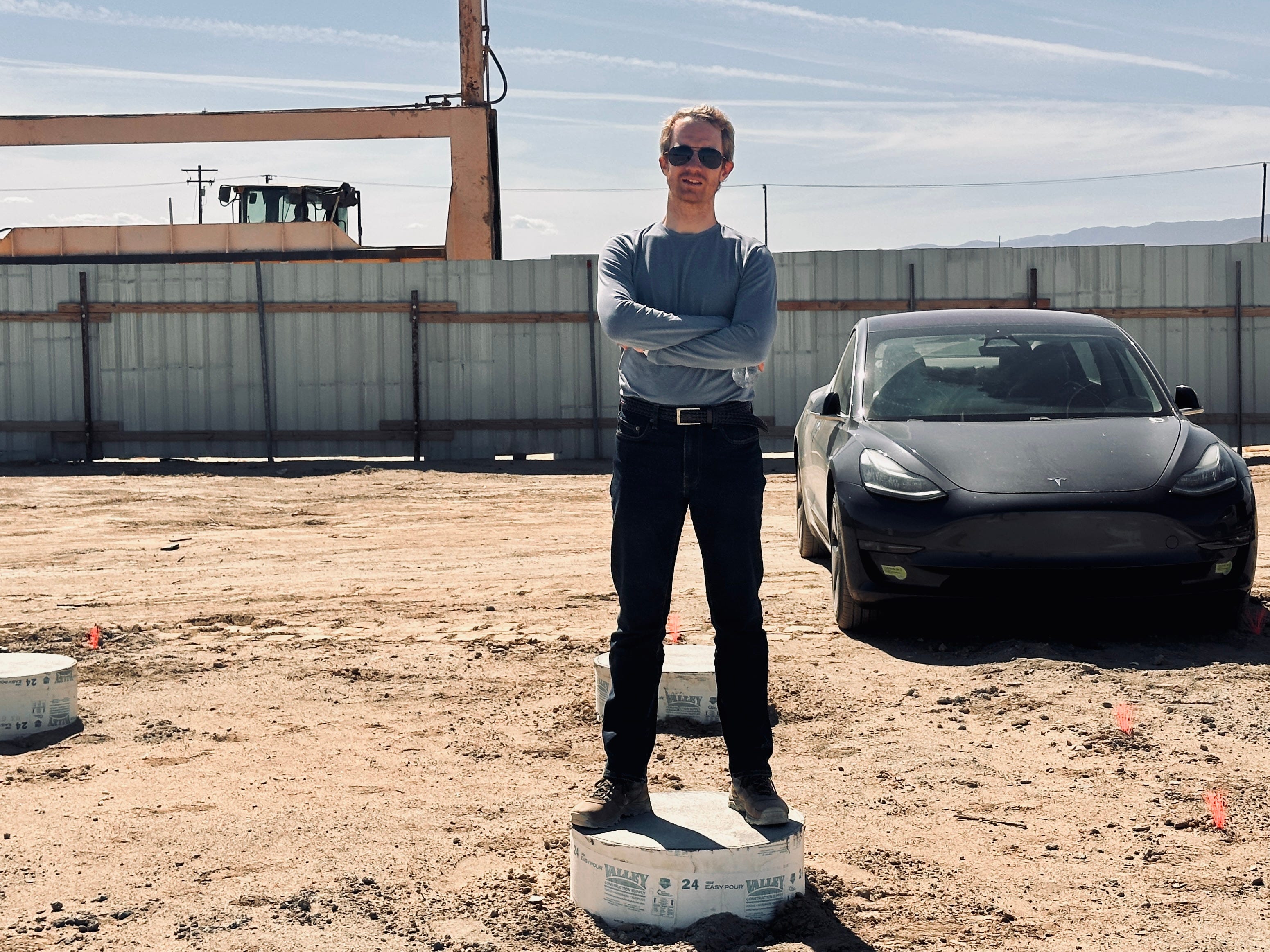
Handmer was eager to open a new fundraising round to take the company to its next stage. He exited the highway and turned onto a narrow dirt road, sandwiched between two chain-link fences. We bounced along for a few more minutes, before pulling onto a barren rectangle of land next to a junkyard. This was Muroc, Terraform Industries’ new test site, named after the airfield where Chuck Yeager first broke the speed of sound.
Concrete piers were already in place for the various subsystems of the Mark One Terraformer. Although the teams back in Burbank had yet to integrate the newest systems, a countdown clock had been installed inside the castle, set to June 15, the ambitious date when everything was supposed to get moved out here.
Handmer had watched other companies get trapped in “analysis paralysis” and convince themselves their mission was impossible. The best thing to do, he believed, was to build a basic demo as fast as possible. “People see it,” he said, “and they go, ‘Oh, this is real.’”
He put on a hard hat and trudged through the powdery soil to the other end of the property, where a semi-autonomous skid steer called the Iris 6 was driving a line of metal pipes into the earth with a ratchet-like din. The Iris 6 had been designed by a company called Planted Solar that would install a thousand solar panels here over the next month—enough to power a hundred homes.
Handmer had been told that permitting for a site like this would take at least four years just about anywhere in the United States, California especially. Terraform Industries had broken ground 53 days after purchasing this plot in January. The cost was more than he wanted to spend, but it was less than everyone told him he would have to spend.
Handmer bent over and pulled up a dry plant stem. “The water in this condensed out of clouds and fell on the ground,” he said grandly. “The carbon came out of a volcano millions of years ago.”
Handmer subscribed to the theory that all life on Earth came from Mars. The conditions on Mars were primed for life’s emergence a hundred million years before it would have been possible here. Each year, several hundred pounds of Martian meteorites crash onto the Earth’s surface. It was not implausible that one of those space rocks landed here with a living payload that made all of this—and all of us—including the vast reservoirs of oil and gas upon which modern civilization was built.
I had once asked Handmer if he ever had any misgivings about leaving the space world behind to found Terraform Industries. “I’m still adjacent,” he told me. “The technology is going to make it to other planets.”
Handmer let the plant stem fall. Beige mountains rose in the distance like giant anthills. The Iris 6 lurched forward, hoisted another pipe, and pounded it into the ground.
I love reading about people and events that pursue ideas that are unconventional. The challenges and opportunities. Who would have thought about reusable rockets. NASA thought it impossible. Yet here we are. A new idea. A different approach. Thinking outside the box. We need more of this rather than rank consumerism.
Great article, thanks for this