


The courier arrived with the human brain early in the morning.
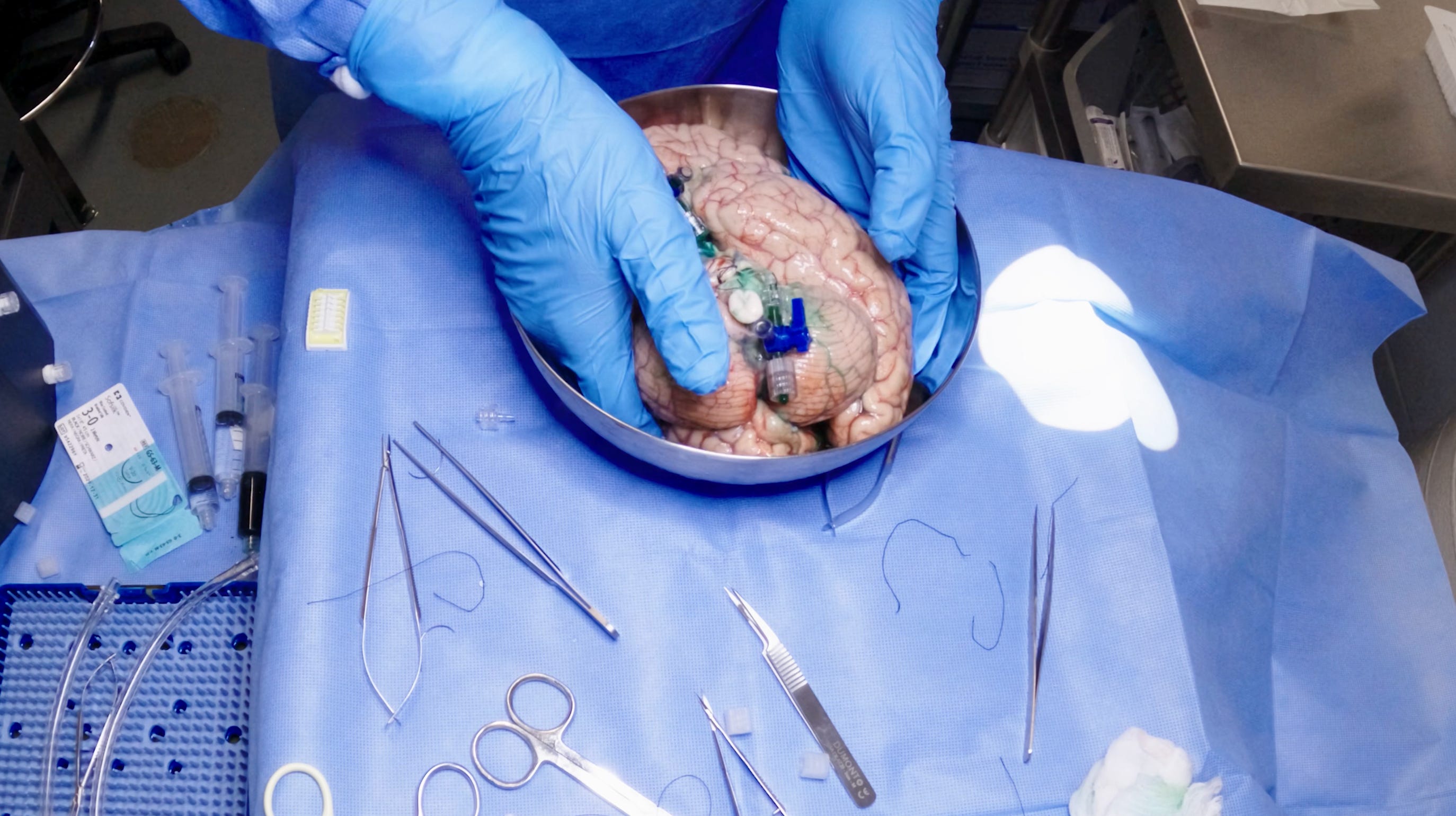
The brain, insulated in a cooler, came in through the back door of a start-up called Bexorg located in New Haven, Connecticut. It then went into the hands of Josip Butkovic, a Croatian-born surgeon, who carried the package to a prep table in Bexorg’s basement. Next, Butkovic removed the brain and placed it in a metal bowl. Gelatinous and shiny, the brain spread out to push against the bowl’s edges.
Butkovic, dressed in scrubs, spent a half-hour inspecting the brain and repairing some of its vasculature. He also began inserting tubes and valves into the organ. Shortly thereafter, he placed the brain onto a cart and transported it upstairs into a room that looked part laboratory and part hospital. It had computers and various types of testing equipment throughout and then several large, rectangular pods that were enclosed in plexiglass and plastic to protect them from things floating in the air and that were filled with medical equipment. Butkovic brought the brain into one of these pods and started to attach it to a machine of Bexorg’s invention – a hardware system that could advance brain science and drug development in astonishing ways.
The machine is what’s known as a perfusion device, meaning that it perfuses or passes fluids and gases through an organ to keep it functional. Doctors use something similar – a heart-lung bypass machine - during open heart surgery to replicate the work of the heart and the lungs and circulate oxygenated blood through the body. No one, though, has created an equivalent machine for the brain - except for Bexorg. The start-up’s scientists, after many years of research, have developed a way to keep a human brain going outside of the body for up to a day.
This is the part of the story where some of you will be wondering if/fearing that the brains have been reanimated and are perhaps once again alive in a thinking or feeling sense. To which, Bexorg’s co-founders - Zvonimir Vrselja and Nenad Sestan - would say, “No.” The brains come from donors and, by the time they arrive at Bexorg, they’ve been dead for several hours. They have no electrical activity. The neurons inside are not firing. What Bexorg is doing is reviving the brains on a molecular level and restoring their base, biological function like metabolizing oxygen and glucose.
The brains Bexorg receives often come from people who were afflicted with conditions like dementia and Parkinson’s and Alzheimer’s disease. Bexorg connects these brains to its perfusion system so that it can test new therapies on the organs and then measure the results. And this is a very big deal because we currently lack a good way to test drugs on the brains of humans. People, after all, don’t like their brains to be experimented on while they’re alive nor is there a convenient means of sampling from a living brain to see what’s happening inside of it.
For these reasons, most new brain therapies are tested first on rodents and then sometimes primates but with abysmal results. By the time a drug gets near a clinical trial in humans, a pharma company might have spent a decade and a $1 billion or more. And, at that point, its drug will likely still fail. Drugs aimed at central nervous system conditions have a failure rate that hovers around 95 percent, while therapies meant to slow or reverse Parkinson’s and Alzheimer’s fail about 99 percent of the time.
Bexorg’s hope, then, is to give researchers a way to test their drugs much earlier on real human brains and to see what works and what doesn’t before tons of money has been spent. “We are not doing this as a research project,” says Vrselja, Bexorg’s CEO. “I want to see therapies for Alzheimer’s and for Parkinson’s. There are people waiting for those drugs, and we want to push as quickly as possible to get those drugs and those cures to them.”


